Model Context Protocol (MCP) Explained: What It Means for Your Website
What Is Model Context Protocol (MCP)?
Model Context Protocol (MCP) is an open standard introduced by Anthropic in late 2024 that defines how AI assistants can connect to external tools, databases, and data sources in a structured, predictable way. Think of it as a universal adapter that lets AI systems—like Claude, ChatGPT, or any other assistant—plug into your business systems, content repositories, or APIs without needing custom integration code for each combination.
For website and business owners, MCP represents a shift in how AI systems will access and understand your content. Instead of AI search engines scraping your HTML pages and trying to guess what's important, MCP provides a clean, structured channel where you can explicitly define what information is available, how it can be accessed, and what actions can be taken. It's the difference between someone rummaging through your filing cabinet versus you handing them a well-organized folder with exactly what they need.
The Technical Foundation (In Plain Language)
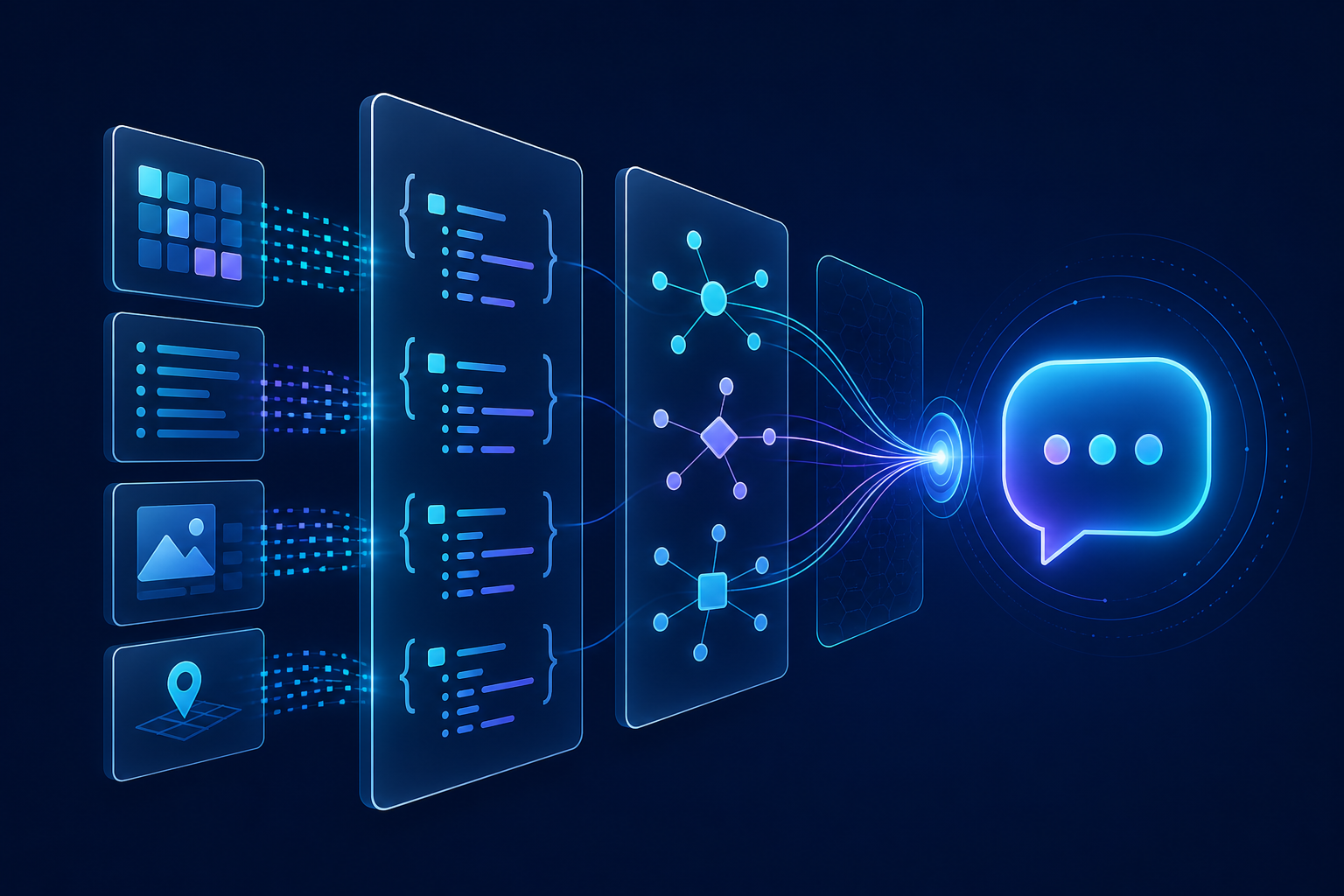
MCP works as a client-server protocol. The "client" is an AI assistant (like Claude Desktop or a future AI search engine), and the "server" is a small program that sits between the AI and your data sources. This server acts as a translator and gatekeeper, exposing your information in a format the AI can understand while maintaining control over what gets accessed and how.
The protocol defines three core primitives that structure how AI systems interact with external systems:
- Resources: These are pieces of content or data the AI can read—think of them as documents, database records, or API endpoints that return information. A resource might be your product catalog, a knowledge base article, or real-time inventory data.
- Tools: These are actions the AI can take—functions it can call to do something. A tool might be "send email," "create support ticket," or "calculate shipping cost." Tools have defined inputs and outputs, so the AI knows what information to provide and what to expect back.
- Prompts: These are reusable templates or workflows that guide how the AI should approach specific tasks using your resources and tools. They're like pre-written instructions that help the AI work with your systems more effectively.
Here's a simple illustrative example of what an MCP tool definition might look like (this is conceptual JSON to show the structure, not production code):
{
  "name": "search_products",
  "description": "Search the product catalog by keyword, category, or price range",
  "inputSchema": {
    "type": "object",
    "properties": {
      "query": {
        "type": "string",
        "description": "Search keywords"
      },
      "category": {
        "type": "string",
        "description": "Product category to filter by"
      },
      "maxPrice": {
        "type": "number",
        "description": "Maximum price in USD"
      }
    },
    "required": ["query"]
  }
}
This tool definition tells an AI assistant exactly what information it needs to provide (a search query, optionally a category and price limit) and what the tool does (searches your product catalog). The AI can then call this tool with structured parameters and receive structured results—no guessing, no parsing messy HTML.
Why MCP Matters for AI Search Visibility
Traditional search engines read your website by crawling HTML pages, extracting text, following links, and using algorithms to guess what's important. This works reasonably well for human-focused search, but it's inefficient and error-prone for AI systems that need to understand relationships, access real-time data, or take actions on behalf of users.
When an AI assistant scrapes your website's HTML, it faces several challenges:
- It must parse visual presentation markup (CSS classes, layout divs) to extract semantic meaning
- It cannot easily access information behind login walls, forms, or interactive elements
- It sees a snapshot of your content at crawl time, missing real-time updates like inventory levels or pricing
- It cannot distinguish between primary content and navigation, advertisements, or boilerplate text without sophisticated heuristics
MCP-style access solves these problems by providing machine-readable, structured interfaces to your content and capabilities. Instead of an AI trying to figure out where your product prices are in your HTML, you explicitly expose a "get_product_details" resource that returns clean, structured data. Instead of an AI attempting to fill out your contact form by simulating clicks and keystrokes, you provide a "submit_inquiry" tool with clear parameters.
This matters for visibility because AI assistants and next-generation search engines will increasingly prefer—and in some cases exclusively use—structured access methods over web scraping. Just as mobile apps largely replaced mobile web browsing for many tasks, AI-native interfaces may prefer MCP-style connections over traditional webpage crawling for information retrieval and task completion.
The Current State: Early Days
As of early 2025, MCP is still in its early adoption phase. Anthropic has released the specification and reference implementations, and a growing number of developers are building MCP servers for popular platforms and data sources. You'll find MCP servers for databases (PostgreSQL, SQLite), productivity tools (Google Drive, Slack), development platforms (GitHub), and various APIs.
However, MCP is not yet widely deployed in production AI search systems. Major search engines and AI platforms are watching the space, and some are experimenting with similar approaches, but there's no immediate requirement for most businesses to implement MCP servers. The protocol is still evolving, best practices are being established, and the tooling ecosystem is maturing.
That said, the direction is clear. Structured, machine-readable access to information is where the AI ecosystem is heading. MCP is one prominent standard in this movement, but even if a different protocol eventually dominates, the underlying principle—providing clean, structured interfaces rather than forcing AI to scrape messy HTML—will remain important.
What Website and Business Owners Should Do Today
The good news: you don't need to panic or rush to implement MCP servers immediately. The bad news: doing nothing forever isn't a great strategy either. Here's a practical approach for most businesses:
Maintain Clean Structured Data
If you already use structured data markup (Schema.org JSON-LD, Open Graph tags, or similar), keep it current and accurate. This structured data serves multiple purposes: it helps traditional search engines understand your content, it provides signals for AI systems, and it represents the kind of clean, semantic information that MCP-style protocols are designed to expose. A website with good structured data is already halfway to being AI-accessible.
Keep Your APIs Well-Documented
If your business has public or partner APIs, ensure they're well-documented with clear specifications (OpenAPI/Swagger is ideal). MCP servers often act as wrappers around existing APIs, so a clean, documented API makes it much easier to add MCP support later. Even if you don't build an MCP server yourself, third parties or AI platforms might build connectors to your API if it's accessible and well-specified.
Think About What You'd Want to Expose
Consider which of your business capabilities would be valuable for AI assistants to access. For an e-commerce site, that might be product search, inventory checking, and order status. For a service business, it might be appointment availability, service descriptions, and contact methods. For a content publisher, it might be article search, author information, and topic categorization. You don't need to build anything yet, but understanding what would be useful helps you prepare for when the time comes.
Monitor the Ecosystem
Keep an eye on how major AI platforms and search engines evolve their approach to external data access. If Google, Microsoft, or OpenAI announce support for MCP or similar protocols in their search products, that's a signal to move faster. If your industry or niche sees early adopters gaining visibility through structured AI access, that's another indicator to prioritize implementation.
Consider Low-Effort Wins
If you use popular platforms (WordPress, Shopify, Salesforce, etc.), watch for MCP plugins or extensions. These might provide basic MCP support with minimal configuration, letting you experiment without significant development investment. Similarly, if you work with a web development agency or have technical staff, asking them to evaluate MCP as part of your next major platform update is reasonable—but it shouldn't drive emergency changes to working systems.
The Bigger Picture: AI-Native Information Architecture
MCP is part of a broader shift toward AI-native information architecture. For decades, we've organized information primarily for human consumption—web pages with navigation menus, visual hierarchies, and prose descriptions. AI systems have adapted to this human-centric format, but it's not optimal for them.
The next generation of information architecture will be dual-purpose: designed for both human and machine consumption. This means:
| Aspect | Human-Centric (Traditional) | AI-Native (Emerging) |
|---|---|---|
| Primary Format | HTML pages with visual styling | Structured data with semantic markup |
| Navigation | Menus, links, breadcrumbs | Defined resources and relationships |
| Interaction | Forms, buttons, clicks | Defined tools with typed parameters |
| Updates | Page refreshes, periodic crawls | Real-time access to current state |
| Access Control | Login pages, session cookies | API authentication, scoped permissions |
MCP provides a framework for the AI-native side of this equation while remaining compatible with traditional web access. A well-implemented MCP server doesn't replace your website—it complements it by offering an alternative, structured interface to the same underlying information and capabilities.
Checking Your Site's Readiness
While full MCP implementation may be premature for many businesses, understanding whether your site has the foundational elements for structured AI access is valuable. Your existing structured data, API documentation, and content organization all contribute to how easily your information can be exposed through protocols like MCP.
Tools like AICompatible.com's free scanner can check your site for many of the foundational elements that make structured AI access possible—things like Schema.org markup, OpenGraph tags, semantic HTML structure, and API discoverability. While these scanners don't specifically test MCP implementation (since most sites don't have it yet), they identify whether you have the building blocks in place for when AI-native protocols become more important.
The key insight is that preparing for MCP-style access isn't about implementing a specific protocol today—it's about maintaining clean, structured, machine-readable information architecture as a general practice. Whether the future brings widespread MCP adoption, a competing standard, or a hybrid approach, sites with good information architecture will adapt more easily than those with messy, unstructured content.
Frequently Asked Questions
Do I need to implement MCP right now to stay competitive in AI search?
No, MCP is still in early adoption and not yet a requirement for AI search visibility. Focus on maintaining good structured data (Schema.org markup) and clean APIs if you have them, which will serve you well regardless of which specific protocols become dominant. Monitor the space and be ready to move when major AI platforms announce concrete support.
Will MCP replace traditional SEO and website optimization?
MCP will complement, not replace, traditional web presence. Humans will still visit websites, and traditional search engines will continue to exist alongside AI assistants. Think of MCP as an additional channel for visibility, similar to how mobile apps complement websites rather than replacing them entirely.
Can I use MCP if I'm not a developer?
Eventually, yes—through plugins, platform extensions, and no-code tools. Currently, implementing an MCP server requires technical expertise, but as the ecosystem matures, expect to see solutions for popular platforms (WordPress, Shopify, etc.) that require minimal technical knowledge. For now, work with your technical team or agency if you want to experiment.
Is MCP only relevant for Anthropic's Claude, or will other AI systems use it?
While Anthropic introduced MCP, it's an open standard that any AI system can adopt. Several other AI platforms and tools have already announced support or are experimenting with it. However, competing standards may also emerge, so the long-term winner isn't certain—but the underlying concept of structured AI access is likely here to stay regardless of which specific protocol dominates.
What's the risk of not preparing for MCP-style protocols at all?
The main risk is reduced visibility in future AI-powered search and assistance tools that prefer or require structured access. If your competitors provide clean, structured interfaces to their information while you rely solely on traditional HTML, AI systems may find it easier to work with their data, potentially directing users to them instead. However, this is a gradual shift, not an immediate cliff, giving you time to adapt as the ecosystem evolves.